My refrigerator clicks but won't start: 8 causes and what to check first
Does your refrigerator click, try to turn on, but the motor doesn't start? Perhaps you hear a small buzzing sound from the back, followed by another click an…
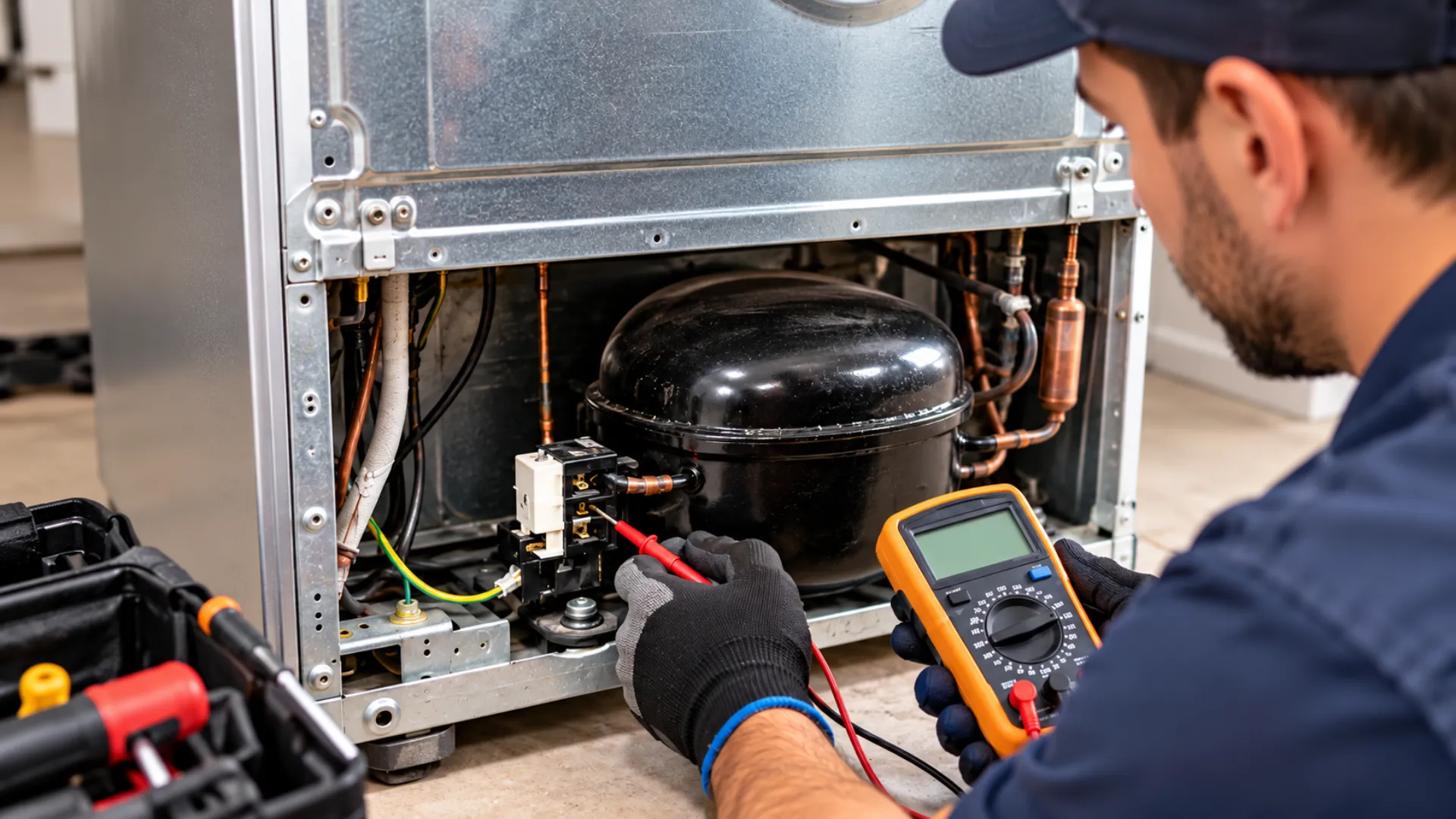
Does your refrigerator click, try to turn on, but the motor doesn't start? Perhaps you hear a small buzzing sound from the back, followed by another click, and then everything goes silent. A few minutes pass, and the same thing happens again.
When a refrigerator clicks repeatedly but doesn't start, the first parts to check are the start relay, the thermal protector, and, if the model uses one, the compressor capacitor. It could also be due to voltage problems, overheating, or an internal motor failure.
The important thing to note is that this noise doesn't automatically mean the compressor is damaged. Often, the problem lies in an external component that's preventing it from working.
In this guide you will learn about the eight causes that can lead to this failure, how to recognize them by their symptoms, and what to check first to avoid unnecessary expenses.
Why does my refrigerator click but not start?
The clicking sound can occur when the electrical system attempts to turn on the compressor, but it fails to start.
In conventional refrigerators, the compressor uses a starting device and a thermal protector. If the motor does not start correctly, it can draw a high current and activate the protection.
When this happens, the protector cuts off the power supply to prevent further damage. After it cools down, it can close the circuit again and allow another start attempt.
That's why some refrigerators exhibit this behavior:
- A click is heard in the back.
- The compressor attempts to start and may produce a buzzing sound.
- Another click is heard and the engine shuts off.
- After a while, the process repeats itself.
This pattern is an important sign that the compressor is not starting , although it does not yet allow us to know which component is failing.
It's also important to distinguish this from a normal click. Some refrigerators make small clicking noises when they activate a relay, change cycles, or stop the motor. If the appliance is cooling properly and the noise is occasional, there isn't necessarily a problem.
What to check first if your refrigerator clicks but doesn't turn on
Before disassembling components or buying spare parts, it is advisable to carry out some simple checks.
1. Check that the electrical outlet is working properly
Unplug the refrigerator and visually inspect the plug and outlet.
Look for signs such as darkened plastic, warping, loose connections, or a burning smell. If you find any of these, do not use that electrical outlet again until it has been checked.
You can also check if the outlet is working by plugging in another low-power appliance that is in good condition.
Keep in mind that an electrical outlet can power a lamp and still have voltage problems when the compressor tries to start.
2. Avoid overloaded extensions and connections
If the refrigerator is connected via an extension cord, power strip, or adapter, check that connection.
Poor contacts and connections that cannot handle the load can cause voltage drops.
It is recommended to use a suitable electrical outlet for the refrigerator, with the voltage and electrical conditions required by the manufacturer.
3. Listen to where the click is coming from.
The location of the noise helps guide the diagnosis.
If it's coming from the lower rear, near the compressor, it may be related to the starting system or thermal protection.
If you hear it in the control panel, it could be coming from an electronic relay or some internal mechanism.
You don't need to open the device to perform this initial check.
4. Check if there is excessive heat in the back
Check if the condenser is covered in dust or if the refrigerator has very little space to ventilate.
It is also advisable to check if the condenser fan, where present, is running during the periods when it should be.
The buildup of heat can cause the compressor to shut down as a safety measure.
5. Check if the problem appeared after a power outage
Some refrigerators incorporate a protection time before restarting after a power interruption.
If the equipment has just regained power, wait the time indicated by its manufacturer.
If the click is repeated, the compressor remains stopped and the refrigerator is not cooling, unplug it and continue with the diagnosis without forcing new attempts.
The 8 reasons why a refrigerator clicks but doesn't start
1. Low voltage or unstable power supply
The compressor needs to receive an adequate voltage to start up.
When the voltage drops too much during startup, the motor may not develop the torque needed to begin rotating.
This can cause a buzzing sound, high current consumption, and the activation of its protection.
Signs that may indicate this problem:
- The refrigerator tries to start, but immediately shuts off.
- The fault appears when other high-consumption appliances are in operation.
- The problem started after a power outage.
- The interior lighting works, although the compressor does not turn on.
To do?
First, check the power supply status without opening any components.
If you suspect a voltage drop, a technician or electrician should measure the voltage under operating conditions and compare it to the data on the equipment's nameplate.
It is not advisable to install just any stabilizer without first determining the cause of the problem and checking its compatibility.
2. Damaged starter relay
The start relay is one of the first components checked when a conventional refrigerator clicks but the compressor does not start.
Its function is to allow the engine to start through the corresponding circuit.
Many domestic refrigerators use a PTC device, which changes its resistance with temperature and is part of the starting system.
When this component fails, the compressor may receive power but fail to start properly.
Common symptoms:
- A click is heard followed by silence.
- The compressor tries to start repeatedly.
- The refrigerator stops producing cold.
- The starter module may show signs of overheating.
How is it verified?
A technician can remove the starter assembly with the equipment disconnected and check its condition, resistance, and compatibility with the compressor.
The correct values depend on the model and type of device. There is no single resistor value that is universally compatible with all PTC relays.
If the component is defective, it must be replaced with another one that meets the appropriate specifications.
It is not recommended to connect the compressor directly to the power supply to try to start it without its protection system.
3. Faulty compressor thermal protector
The thermal protector, also known as overload or overload protector, interrupts the power supply when it detects dangerous temperature or current conditions.
Its function is to protect the compressor windings.
When the motor tries to start and fails, the protector can open the circuit and produce the click you hear.
However, there are two different situations that should be distinguished.
Protector working correctly: interrupts the current because there is another fault, such as a faulty relay, insufficient voltage or a blocked compressor.
Defective protector: may open the circuit abnormally or have internal problems that prevent the motor from functioning.
Therefore, hearing the screen protector click doesn't necessarily mean you should replace it.
What to check?
A technician can check its continuity when it is at a suitable temperature and compare its behavior with the corresponding specifications.
If it is open because it has just reacted to temperature, an immediate measurement may lead to a false conclusion.
The correct repair involves identifying why it is activating and replacing it only when it is confirmed to be damaged.
4. Faulty start or run capacitor
Some compressors use capacitors to facilitate starting or improve their operating conditions.
Not all refrigerators incorporate a separate start capacitor, so you must first identify the system your model uses.
When a capacitor necessary for the operation of the motor loses capacity or malfunctions, the compressor may have difficulty starting.
Symptoms may include a brief buzzing sound, failed startup attempts, and activation of the thermal protector.
How to identify the fault?
The technician must check the capacitance with a suitable instrument and compare it with the nominal value and tolerance indicated on the component.
A visual inspection can also reveal deformations or damage, although a seemingly normal capacitor may be defective.
If a replacement is needed, one of the correct type, with the specified capacitance and appropriate voltage rating, must be used.
Important: Capacitors can retain an electrical charge even after the refrigerator is unplugged. Do not tamper with their terminals or attempt to discharge them improperly.
5. Compressor overheated due to lack of ventilation
The compressor generates heat during operation and needs the condensation system to be able to dissipate it properly.
When the condenser is too dirty or the corresponding fan stops working, the operating temperature may increase.
If overheating becomes excessive, the protection system may stop the compressor.
In that case, the refrigerator might try to start again after cooling down.
What to check?
- Dust accumulation in the condenser.
- Insufficient ventilation around the refrigerator.
- Condenser fan stopped or blocked, if the model has one.
- Obstructed ventilation grilles.
To clean accessible areas, first unplug the refrigerator and use a soft brush or vacuum cleaner, following the manufacturer's instructions.
Do not force the blades or tamper with internal cables.
If the problem persists after correcting the ventilation, it will be necessary to check the electrical components and the condition of the compressor.
6. Loose, burned, or corroded electrical connections
A faulty connection can cause starting failures even when the relay, protector and compressor are in good condition.
Over time, some terminals may loosen, oxidize, or deteriorate due to heat.
This increases the electrical contact resistance and can cause a voltage drop when the motor demands current to start.
Warning signs:
- Smell of burnt plastic.
- Darkened or deformed connectors.
- Intermittent operation.
- Clicking sounds accompanied by abnormal heating.
If you notice any of these signs, unplug the refrigerator.
Damaged connections must be repaired properly, using appropriate terminals and materials. Simply covering an overheated contact with electrical tape is not enough.
It is also important to inspect the compressor terminals, a task that should be carried out by trained personnel.
7. Faulty electronic board, thermostat, or inverter module
This depends especially on the type of refrigerator.
In conventional models, a mechanical thermostat can control the cooling system's power supply.
If its contacts fail, the compressor may not receive the start command correctly. The thermostat itself may produce a click, although that is different from the repetitive click of a thermal overload protector.
In electronic refrigerators, the control board uses sensors and circuits to manage the operation of the compressor.
If any component fails, it may prevent startup or generate incorrect activation attempts.
What happens in an inverter refrigerator?
Many inverter refrigerators use an electronic module that directly controls the operation of the compressor.
Therefore, they are not diagnosed in the same way as conventional systems that use a PTC relay connected to the motor terminals.
In these devices, it is advisable to check the error codes, connectors, and power and control signals of the module, according to the manufacturer's technical documentation.
It is not recommended to replace the inverter board without first checking if it is receiving the correct signals.
8. Compressor blocked or with internal damage
If the power supply is correct and the external components are functioning properly, the problem could be inside the compressor itself.
A motor with mechanical difficulties may attempt to start, produce a buzzing sound, and draw too much current until the protection kicks in.
There may also be open windings, internal short circuits, or insulation failures.
What symptoms might indicate a damaged compressor?
- The motor hums, but it never actually starts.
- The thermal protector acts repeatedly.
- The external boot components have already been checked.
- The electrical consumption during start-up attempts is abnormal.
To confirm this fault, a technician must check the electrical condition of the windings, their insulation, the power supply and the behavior of the motor.
If the compressor has an internal mechanical failure or irreversible electrical damage, it will generally need to be replaced.
Before authorizing the work, request that external components and power supply issues be ruled out. Replacing a compressor is a considerably more complex procedure than replacing a start relay.
Diagnostic table: Identify the fault based on the sound of your refrigerator
Even if two refrigerators make similar noises, they may have different problems. This table will help guide your initial inspection.
| Observed symptom | Possible cause | What to check first |
|---|---|---|
| It clicks, buzzes briefly, and then shuts off. | Relay, capacitor, protector or compressor | Starting and power system |
| It clicks every few minutes and doesn't cool down. | Failed startup attempts | Relay, protector and voltage |
| The compressor is very hot and shuts off. | Overload or overheating | Ventilation and condenser |
| The light comes on, but there's no sound from the engine. | Control, thermostat or starting system | Refrigerator type and power-on sequence |
| It clicks after a power failure | Unstable power supply or protection delay | Power outlet and wait time |
| Click from the electronic card | Control relay or electronic circuit | Control card and signals |
| It clicks, but then it starts and cools down normally. | Normal operation or intermittent start-up | Noise frequency and indoor temperature |
The table is for guidance only. A sound alone does not confirm that a part is damaged.
How to tell if the problem is in the relay or the compressor
This is one of the most important questions, because the cost of repairing a relay is not usually comparable to that of replacing a compressor.
To differentiate between the two failures, the diagnosis must follow a specific order.
First: check the power supply. Verify that the refrigerator is receiving the correct voltage and that there are no faulty connections.
Second: check the starting system. In a conventional compressor, check the relay, the thermal protector, and the capacitor, if present.
Third: evaluate the compressor. If everything above works correctly and the motor still does not start, it will be necessary to measure its windings, insulation, and electrical behavior.
It is not enough to hear a click and claim that the compressor is burned out.
It's also not a good idea to buy a new relay just because the motor is trying to start. The problem could be elsewhere.
If you need to better understand these differences, you can consult our guide on the operation and common failures of a refrigerator compressor .
What to do if the refrigerator keeps clicking and isn't cooling?
When the failure recurs and the compressor never starts, the wisest course of action is to stop the starting attempts.
Continuing to plug and unplug the equipment does not help identify the cause and may aggravate an existing problem.
If you have already checked the power supply and ventilation, the next step is a technical diagnosis of the starting system.
Meanwhile, try to move perishable food to another refrigerator that is working properly to prevent it from spoiling.
You can also use our digital and analog refrigerator diagnostic tool , where you can describe the symptom and follow a check guide.
What shouldn't you do?
Avoid these practices in particular:
- Hit the compressor to try to unblock it.
- Connect the motor terminals directly to the power supply.
- Remove or bypass the thermal protector.
- Installing a capacitor of a different value without technical justification.
- Changing cable positions without identifying the connections.
- Manipulating an electronic card while it is powered on.
- Open pipes or interfere with the refrigerant circuit without proper training and equipment.
An incorrect diagnosis can turn a simple repair into a much more expensive breakdown.
When is it advisable to call a technician?
If the refrigerator makes repetitive clicking noises, does not produce cold air, and the compressor does not start, it is advisable to request a check-up when external checks do not solve the problem.
You should also stop using it if you find a burning smell, overheated wires, sparks, or signs of electrical damage.
To facilitate diagnosis, provide the technician with this information: make and model, time elapsed since the fault began, frequency of clicks, whether the compressor is humming, and whether the unit has completely stopped cooling.
These details help identify where to start without replacing parts unnecessarily.
If the motor is running but the internal temperature isn't decreasing, the problem might be different. In that case, check out our guide on why a refrigerator isn't cooling and what the possible causes are .
10 frequently asked questions about a refrigerator that clicks but doesn't start
1. Why does my refrigerator click but not turn on?
There could be a problem with the compressor's starting system, the thermal protector, the capacitor, or the power supply. When the clicking sound is repeated and the refrigerator isn't cooling, these components need to be checked before concluding that the motor is damaged.
2. What does it mean that the compressor clicks every five minutes?
This could mean the compressor is trying to start, but it fails, and its thermal protector cuts off the power. After it cools down, the system allows another attempt. The interval can vary depending on the component and operating conditions; five minutes is not a fixed time for all equipment.
3. How can I tell if the refrigerator's start relay is damaged?
A faulty relay can cause failed start attempts, buzzing, and repetitive clicking sounds. To confirm this, you need to check the relay type, its connections, and its electrical characteristics. Its external appearance or the sound it makes when moved are not sufficient evidence on their own.
4. What happens if my refrigerator's compressor is hot and won't start?
The thermal protector may be tripping due to overheating or high starting current. Causes include insufficient ventilation, incorrect voltage, starting failure, or internal motor damage. Do not attempt to touch an excessively hot compressor or force it to operate.
5. Why does my refrigerator light turn on, but the motor doesn't start?
The lighting and the compressor use circuits with different functions. The light turning on confirms that there is some power, but it doesn't guarantee that the compressor is receiving the correct voltage. There could also be faults in the thermostat, the electronic control board, or the starting system.
6. Can a damaged capacitor prevent a refrigerator from starting?
Yes, when the compressor design requires that capacitor to start or operate correctly. If it has lost capacitance or is faulty, the motor may not start. However, not all refrigerators use a separate start capacitor.
7. Can a compressor that hums and then clicks be repaired?
It depends on the cause. If the problem is with the relay, the protector, or the capacitor, it can be fixed by replacing the faulty component. If there is an internal mechanical blockage or serious damage to the windings, the compressor will usually need to be replaced.
8. Why does an inverter refrigerator click but not start?
The noise could be coming from the control board, an electronic relay, or another mechanism. In many inverter systems, the compressor is operated by an electronic module and does not use the same starting system as a conventional motor. It is important to consult the error codes and the manufacturer's specific instructions.
9. Can a lack of refrigerant gas cause a refrigerator not to start?
A refrigerant leak usually causes the unit to cool poorly or stop cooling altogether, but it's not the typical cause of a repetitive clicking sound accompanied by failed start attempts. If the compressor doesn't even start, the power supply and electrical starting system should be checked first.
10. How much does it cost to repair a refrigerator that clicks but won't start?
The cost depends on the faulty component, its make, and model. Replacing a relay or thermal protector is usually a much simpler repair than replacing a compressor. Before accepting a quote, ask for identification of the defective part and an explanation of the tests that confirmed the failure.
Conclusion
If your refrigerator clicks but doesn't start, it doesn't necessarily mean you need to replace the compressor.
The first step is to rule out power supply and ventilation problems. Next, check the start relay, the thermal protector, and the capacitor, if the unit uses one.
The key is to identify what's causing the clicking sound and why the motor isn't starting. A thorough diagnosis can help you avoid unnecessary replacements, reduce repair costs, and prevent further damage.
Does your refrigerator click only once or try to start every few minutes? Tell us in the comments the brand, model, and what sound you hear. These details can help us better diagnose the problem.