How to calculate voltage and resistance using Ohm's law: formulas and examples
To calculate the voltage of an electrical circuit, multiply the current in amperes by the resistance in ohms (V = I × R). If you need to calculate the
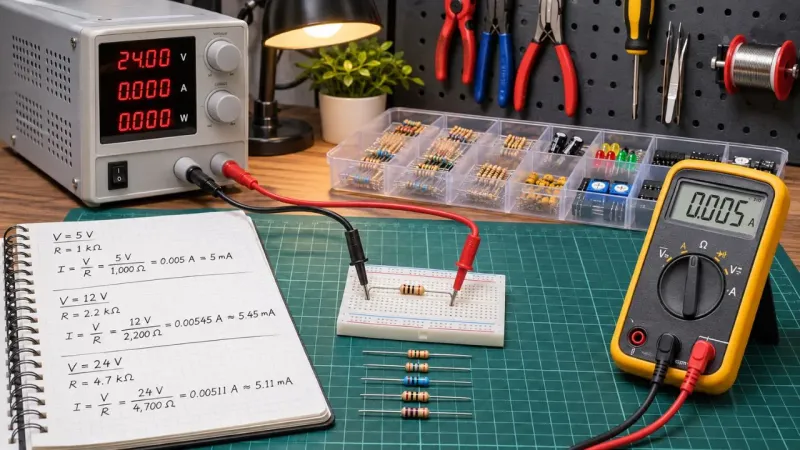
To calculate the voltage of an electrical circuit, multiply the current in amperes by the resistance in ohms (V = I × R). If you need to calculate the resistance, divide the voltage by the current (R = V ÷ I). These two operations are derived from Ohm's Law and allow you to solve numerous electrical and electronic problems.
For example, if a 6-ohm resistor has a current of 2 amps, the voltage across its terminals is:
V = 2 A × 6 Ω = 12 V
And if you know that a component has 12 volts between its terminals and a current of 0.5 amps flows through it:
R = 12 V ÷ 0.5 A = 24 Ω
In this guide you will learn how to use both formulas, solve problems with 5V, 12V and 24V circuits, interpret electrical units and check your calculations with our free calculator.
What does Ohm's law state and what is it used for?
Ohm's law describes the relationship between voltage, electric current, and the resistance of a conductor or component that exhibits ohmic behavior.
In simple terms, it states that, when resistance remains constant, current increases when voltage increases and decreases when resistance increases.
This relationship is expressed by the formula:
V = I × R
Ohm's law is used to calculate electrical values, analyze circuits, solve academic problems, and understand the operation of resistors and other elements.
It is especially useful in direct current circuits with resistive components.
However, not all devices exhibit constant resistance. Diodes, some sensors, and other electronic components can have nonlinear behavior. In these cases, it is necessary to consider their specific characteristics.
Difference between volts, amps, and ohms
Before starting the calculations, it is helpful to understand what each quantity represents.
| Magnitude | Symbol | Unit | What does it represent? |
|---|---|---|---|
| Voltage | V | Volt (V) | Electrical potential difference |
| Current | Yo | Ampere (A) | Electric charge flow per unit of time |
| Endurance | R | Ohm (Ω) | Opposition to the flow of current |
Voltage: is the difference in electrical potential between two points. A power supply can provide, for example, 5 V, 12 V, or 24 V.
Current: expresses the amount of electric charge that passes through a point in the circuit per unit of time.
Resistance: indicates the opposition a component presents to the flow of current. It is measured in ohms.
These three quantities are related. Therefore, when we know two values corresponding to the same resistive element or circuit, we can calculate the third.
Formula for calculating voltage using Ohm's law
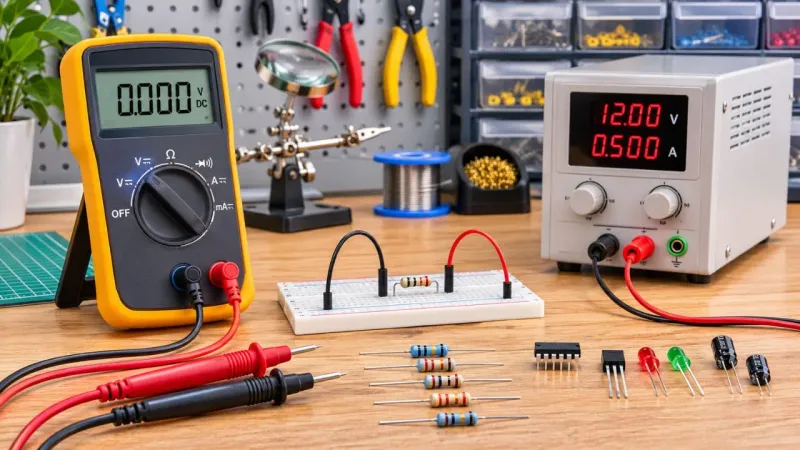
If you know the current and resistance, use:
V = I × R
Where:
- V is the voltage in volts.
- I is the current in amperes.
- R is the resistance in ohms.
Example: Calculating the voltage across a resistor
Imagine a circuit through which 3 amps flow through a 4 ohm resistor.
Step 1. Identify the data.
Current: 3 A.
Resistance: 4 Ω.
Step 2. Apply the formula.
V = I × R
Step 3. Substitute the values.
V = 3 × 4
Result: 12 V.
The potential difference between the terminals of that resistor is 12 volts.
This procedure also allows calculating voltage drops in resistive components when their resistance and the current passing through them are known.
How to calculate electrical resistance with voltage and current
Once you know the voltage and the amperage, you can solve for the resistance:
R = V ÷ I
For example, if a resistor has 24 V between its terminals and a current of 2 A flows through it:
R = 24 ÷ 2
Result: 12 Ω.
This means that the resistance corresponding to that voltage and current relationship is 12 ohms.
To obtain a valid result, the voltage and current must correspond to the same component or set of elements that you are analyzing.
You should also remember that a non-linear component can exhibit different V/I values depending on its operating point.
Solved exercises on Ohm's law with 5 V, 12 V and 24 V
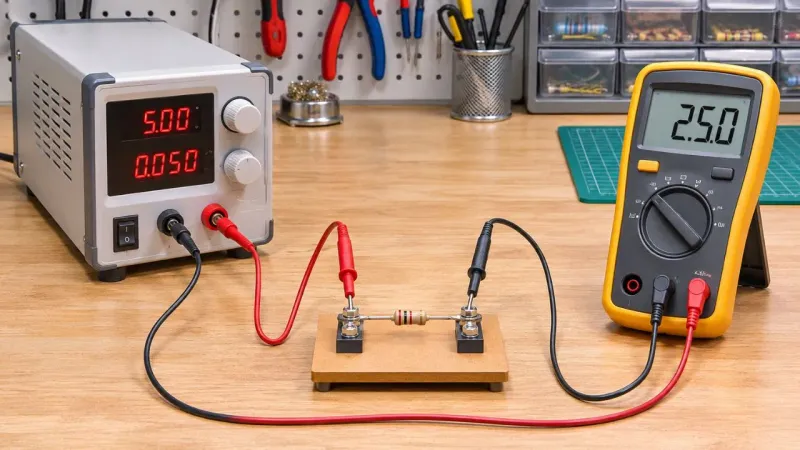
We are going to solve three different exercises using direct current resistive circuits.
Exercise 1. Calculate the resistance in a 5-volt circuit
An electronic circuit uses a 5V power supply and a resistor through which 20 milliamperes (mA) flow.
How much is that resistance worth?
Step 1. Convert milliamps to amps.
20 mA = 0.020 A
Step 2. Use the resistance formula.
R = V ÷ I
Step 3. Replace the data.
R = 5 ÷ 0.020
Result: 250 Ω.
The resistance is 250 ohms.
Check: 0.020 A × 250 Ω = 5 V.
This type of operation is common when studying low-voltage electronic circuits.
Exercise 2. Calculate voltage with a resistance of 24 ohms
A current of 0.5 A flows through a 24 Ω resistor.
What is the voltage between its terminals?
Step 1. Identify the values.
I = 0.5 A
R = 24 Ω
Step 2. Apply the formula.
V = I × R
Step 3. Solve.
V = 0.5 × 24
Result: 12 V.
The resistor has a voltage drop of 12 volts.
Check: 12 V ÷ 24 Ω = 0.5 A.
Exercise 3. Calculate the resistance in a 24-volt circuit
Imagine a resistive load connected to a 24 V source that draws 0.3 A.
What resistance does it offer?
Step 1. Write down the data.
V = 24 V
I = 0.3 A
Step 2. Select the formula.
R = V ÷ I
Step 3. Perform the division.
R = 24 ÷ 0.3
Result: 80 Ω.
The resistance is 80 ohms.
Check: 0.3 A × 80 Ω = 24 V.
The three exercises use different formulas depending on the value we need to calculate. The procedure always begins by identifying the known data and selecting the appropriate equation.
Practical table for calculating voltage and resistance
This table brings together examples of resistive direct current circuits.
| Voltage | Current | Endurance |
|---|---|---|
| 5 V | 0.02 A | 250 Ω |
| 5 V | 0.1 A | 50 Ω |
| 12 V | 0.5 A | 24 Ω |
| 12 V | 2 A | 6 Ω |
| 24 V | 0.3 A | 80 Ω |
| 24 V | 1.2 A | 20 Ω |
You can check any row by multiplying current by resistance.
For example:
1.2 A × 20 Ω = 24 V.
You can also divide the voltage by the current to check the resistance:
24 V ÷ 1.2 A = 20 Ω.
How are voltage, current, and resistance related?
To better understand Ohm's law, imagine a 6 Ω resistor connected to different voltages.
- At 6 V, 1 A flows.
- At 12 V, 2 A flow.
- At 24 V, 4 A flow.
When resistance remains constant, doubling the voltage also doubles the current.
Now consider a source that maintains 12V.
If you connect a 6 Ω resistor, the current will be 2 A.
But if the resistance increases to 12 Ω, the current decreases to 1 A.
At constant voltage, a higher resistance produces a lower current in an ohmic circuit.
This relationship explains much of the behavior of simple resistive circuits.
How to apply Ohm's law in series and parallel circuits
In circuits with multiple resistors, you must first identify how they are connected.
Resistors in series
In a series connection, the same current flows through all the resistors.
If you connect two resistors of 2 Ω and 4 Ω in series:
R total = 2 + 4 = 6 Ω.
With a 12V power supply:
I = 12 ÷ 6 = 2 A.
The first resistor will have a voltage drop of 4V and the second one of 8V.
The sum is 12 V, equal to the total voltage of the ideal source.
Resistors in parallel
In a parallel connection, the resistors share the same voltage between their terminals.
For example, if you connect 12 Ω and 24 Ω resistors in parallel to 24 V:
- Current through the 12 Ω resistor: 2 A.
- Current through the 24 Ω resistor: 1 A.
- Total current: 3 A.
The equivalent resistance is 8 Ω.
This example demonstrates why you should not use the voltage of the entire circuit along with the current of a single branch to calculate an equivalent resistance.
Difference between the resistance of a component and that of an electrical installation
The resistance of an electronic component is not the same as all the electrical characteristics of an installation.
A commercial resistor can have a nominal value of 100 Ω or 1,000 Ω, accompanied by a tolerance and a maximum permissible power.
On the other hand, electrical cables also exhibit resistance, but this depends on factors such as the conductive material, length, cross-section, and temperature.
Other properties are also evaluated at the facilities:
- Insulation resistance.
- Continuity of drivers.
- Circuit impedance.
- Grounding conditions.
- Current carrying capacity.
These values have different functions and should not be confused.
For example, calculating resistance using V/I does not automatically determine if a cable has the appropriate cross-section or if an installation meets safety requirements.
In alternating current, motors and other devices can also exhibit reactance, so it may be necessary to work with impedance and not just resistance.
Free online Ohm's law calculator
If you need to solve several exercises, you can use our online Ohm's Law calculator from Mosan Multiverse.
The tool allows you to calculate voltage, current, and resistance using fundamental electrical relationships.
How to use the calculator
- Open the tool from the link above.
- Select the option that corresponds to Ohm's law.
- Choose the quantity you need to calculate.
- Enter the two known values.
- Press the calculate button and check the result.
For example, if you want to calculate the voltage, enter a current of 2 A and a resistance of 6 Ω.
The result will be 12 V.
You can also use it to check previous exercises and detect errors when performing manual operations.
The calculator is used to solve electrical relationships; it does not replace actual measurements or safety checks of an installation.
Common mistakes when calculating voltage and resistance
| Mistake | How to avoid it |
|---|---|
| Confusing amperes with milliamps | Convert mA to A before calculating |
| Confusing ohms with kiloohms | Remember that 1 kΩ = 1,000 Ω |
| Using an incorrect formula | For voltage, multiply; for resistance, divide. |
| Mixing data from different components | Use values corresponding to the same element |
| Divide by current equals zero | It recognizes that R = V/I is not defined for I = 0 |
| Assume that all loads are resistive | Consider the actual behavior of the component |
| Confusing resistance with power | Ohms and watts represent different magnitudes |
Another mistake is calculating the resistance of a component that changes temperature considerably as if its value remained constant.
For example, the resistance of certain filaments and sensors varies with temperature. In these cases, the operating conditions must be considered.
Caution: Never use the ohms function of a multimeter on a live circuit. Resistance measurements should be taken with the equipment disconnected and following the appropriate safety procedure.
Frequently asked questions about how to calculate voltage and resistance
1. What is the formula for calculating voltage?
The formula is V = I × R. Multiply the amperes by the ohms. For example, a current of 2 A through a resistance of 10 Ω produces a voltage drop of 20 V.
2. How do I calculate resistance if I have voltage and amperage?
Divide the voltage by the current using R = V ÷ I. If you have 12 V and 0.5 A, the resistance is 24 Ω.
3. How to calculate volts using Ohm's law?
You need to know the current and the resistance. Multiply both values to obtain the potential difference between the terminals of the element being analyzed.
4. How many ohms are 12 volts?
There is no fixed equivalence between volts and ohms. You also need to know the current. If 1 A flows with 12 V applied, the resistance is 12 Ω.
5. What happens if the electrical resistance increases?
In an ohmic circuit powered by a constant voltage, increasing the resistance decreases the current. For example, at 12 V, a 6 Ω resistor allows 2 A, while a 12 Ω resistor allows 1 A.
6. How to convert kiloohms to ohms?
Multiply the value by 1,000. For example, 4.7 kΩ is equivalent to 4,700 Ω.
7. Does Ohm's law apply to alternating current?
Yes, it can be applied to purely resistive loads using RMS voltage and current values. When significant inductive or capacitive effects are present, the circuit impedance must be considered.
8. Is Ohm's law the same as the power formula?
No. Ohm's law relates voltage, current, and resistance using V = I × R. Electrical power is expressed in watts and, in direct current, is calculated using P = V × I. These are different relationships that can be combined to analyze a circuit.
Conclusion
Calculating voltage and resistance with Ohm's law is simple when you correctly identify the data and use the appropriate formula.
If you know the current and the resistance, multiply both values to obtain the voltage. If you know the voltage and the current, divide them to calculate the resistance.
Practicing with 5V, 12V, and 24V circuits will help you understand these relationships and solve problems with greater confidence.
To quickly check your calculations, use our free online Ohm's Law calculator and compare the results with your manual calculations.