How to calculate amps with watts and volts: formula, examples, and online calculator
To calculate amps using watts and volts, divide the electrical power in watts by the voltage in volts. The formula is I = P ÷ V, where I represents the
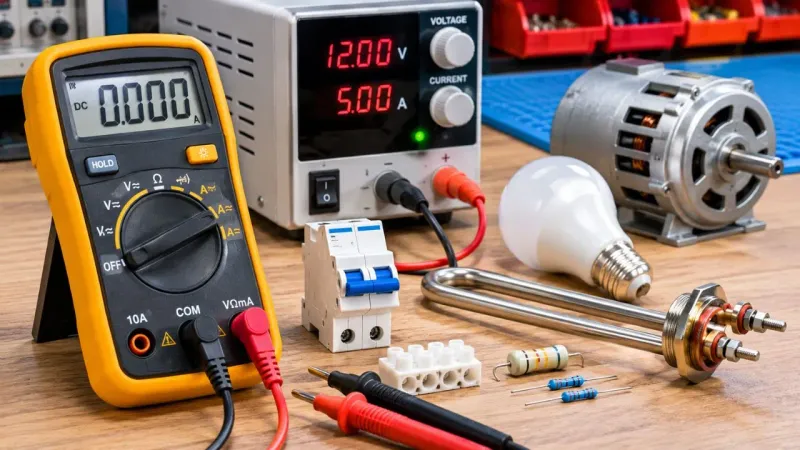
To calculate amperes using watts and volts, divide the electrical power in watts by the voltage in volts. The formula is I = P ÷ V , where I represents the current in amperes, P the power in watts, and V the voltage.
For example, if you have a 600-watt device that operates at 120 volts, the calculation is:
600 W ÷ 120 V = 5 amps.
This means that the device consumes 5 amps under the conditions considered.
The formula is straightforward for direct current (DC) and for purely resistive loads in alternating current (AC). For motors, compressors, and other AC equipment, it may also be necessary to know the power factor to correctly calculate the current.
In this guide, you'll learn how to calculate amperes step by step, convert watts to amperes, use Ohm's Law, and solve examples with 12V, 120V, and 220V. You can also perform your calculations using our free electrical calculator.
What is the formula for calculating amperes?
The basic formula for obtaining electric current from power and voltage is:
I = P ÷ V
Where:
- I: electric current measured in amperes (A).
- P: electrical power measured in watts (W).
- V: voltage or electrical tension measured in volts (V).
This relationship is obtained by solving for current in the electrical power formula:
P = V × I
To apply it correctly, you need to know the electrical power used by the circuit and the voltage at which it operates.
How to calculate amps step by step
The procedure is simple:
- Identify the device's power in watts.
- Check the operating voltage.
- Divide the watts by the volts.
- Express the result in amperes.
For example, for a resistive load of 240 watts connected to 120 volts:
I = 240 ÷ 120 = 2 A
The result is a current of 2 amps.
It is important to use values corresponding to the same circuit and the same operating conditions.
Difference between amps, volts and watts
Although these three magnitudes are related, they do not mean the same thing.
What are amps?
The ampere is the unit used to measure the intensity of electric current.
It indicates how much electric charge passes through a point in the circuit per unit of time.
For example, when a device consumes 5 A, it means that a current of 5 amperes flows through its circuit.
What are volts?
The volt measures the difference in electrical potential between two points.
This voltage allows current to flow when there is a closed circuit and a connected load.
You can find equipment designed to work at 12V, 120V, 220V and other voltages.
What are watts?
The watt represents electrical power, that is, the speed at which energy is transferred or transformed.
For example, a heating element that consumes 1,000 W transforms electrical energy mainly into heat.
The fundamental difference is that volts represent voltage, amps represent current, and watts represent power .
Knowing these magnitudes allows for a better understanding of how electrical devices work.
How to calculate amps with 12 volts
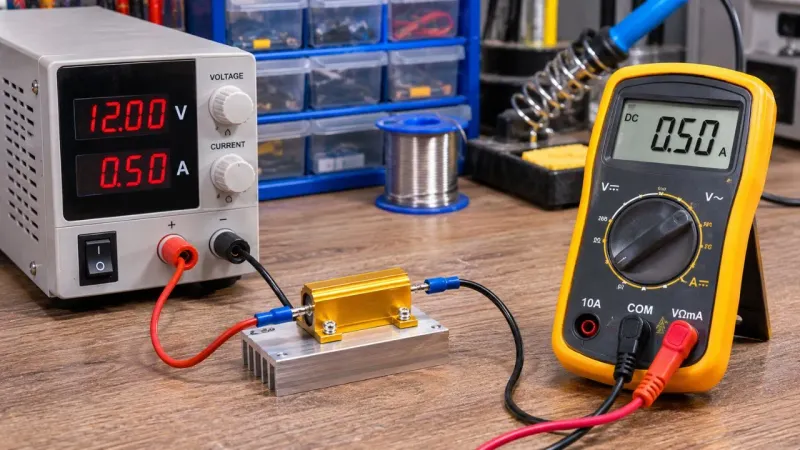
12V circuits are common in battery systems, LED lighting, and some electronic equipment.
Imagine you have a DC load that uses 60 watts and operates at 12 volts.
We apply the formula:
I = P ÷ V
We substitute the values:
I = 60 W ÷ 12 V
Result: 5 A
Therefore, the load consumes 5 amps when it receives 12 V and uses 60 W.
Another example with a 12V battery
Let's assume a load consumes 24 W.
I = 24 ÷ 12 = 2 A
In this case, the current is 2 amps.
Remember that the actual voltage of a battery can vary depending on its state of charge and operating conditions. The examples use a constant 12V for ease of learning.
How to calculate amps with 120 volts
Now imagine a 600-watt heating element connected to a 120-volt power supply.
Since we are considering a purely resistive load, we can directly use:
I = 600 ÷ 120
Result: 5 A
This means the current is 5 amps.
If we increase the power to 1,200 watts, keeping the same voltage:
I = 1,200 ÷ 120 = 10 A
The current increases because the power is greater while the voltage remains constant.
This relationship is especially useful for understanding the consumption of resistive loads such as electric heaters.
How to calculate amps with 220 volts
For this example we will use an electrical resistor of 1,100 watts connected to 220 volts.
We apply the formula:
I = 1.100 ÷ 220
Result: 5 A
Now let's consider a 2,200 W resistor operating at the same voltage.
I = 2.200 ÷ 220 = 10 A
These calculations show the relationship between power, current, and voltage.
For example, a load of 1,100 W at 220 V consumes 5 A, while that same power at 110 V would require 10 A, assuming ideal conditions and that the load maintains the same power.
Important: These examples do not mean that any appliance can be connected interchangeably to 110V or 220V. You must always respect the voltage specified by the manufacturer.
How to calculate amperes using Ohm's law
There is another way to calculate electric current when we know the voltage and resistance of the circuit.
Ohm's law states:
V = I × R
If we solve for the current, we get:
I = V ÷ R
Where:
- I: current in amperes.
- V: voltage in volts.
- R: electrical resistance in ohms (Ω).
Practical example
Let's assume we connect a 6-ohm resistor to a 12-volt DC power source.
I = 12 ÷ 6
Result: 2 amps.
This means that 2 A will flow through the resistor, assuming its value remains constant.
In alternating current circuits with inductances or capacitances, impedance also plays a role. Therefore, it is not always correct to use only resistance to obtain the current.
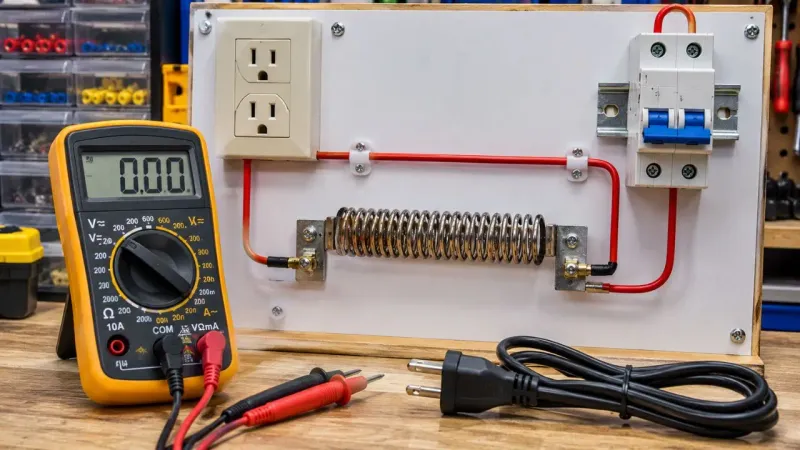
How to calculate amperes in alternating current
So far we've used the direct relationship between watts and volts. However, in alternating current, other factors can come into play.
Electric motors, compressors, and certain electronic equipment do not always have a power factor equal to 1.
What is power factor?
The power factor (PF) relates active power, expressed in watts, to apparent power, expressed in volt-amperes (VA).
In a single-phase circuit, using the effective values of voltage and current, the following holds true:
P = V × I × FP
Therefore:
I = P ÷ (V × FP)
This formula allows us to calculate the current when we know the active input power, the voltage, and the actual power factor of the equipment.
Example with a power factor of 0.8
Imagine a single-phase device that consumes 600 W at 120 V and has a power factor of 0.8.
I = 600 ÷ (120 × 0.8)
I = 600 ÷ 96
Result: 6.25 A
Notice the difference:
- With a power factor of 1:5 A.
- With a power factor of 0.8: 6.25 A.
Therefore, simply dividing 600 by 120 does not always provide the actual current of a motor or electronic device.
A different formula is also used in balanced three-phase systems:
I = P ÷ (√3 × V × FP)
In this case, V represents the line-to-line voltage and P the total active input power.
If the stated power of a motor corresponds to its mechanical output, its performance or efficiency must also be considered to estimate the electrical input current.
Table for converting watts to amps
The following table shows conversion examples for direct current or purely resistive loads, considering constant voltages.
| Power | Voltage | Current |
|---|---|---|
| 24 W | 12 V | 2 A |
| 60 W | 12 V | 5 A |
| 48 W | 24 V | 2 A |
| 120 W | 120 V | 1 A |
| 600 W | 120 V | 5 A |
| 1,200 W | 120 V | 10 A |
| 440 W | 220 V | 2 A |
| 1,100 W | 220 V | 5 A |
| 2,200 W | 220 V | 10 A |
These values are theoretical calculations. To estimate the current of AC equipment with a power factor other than 1, you must use the corresponding formula.
Free online calculator for amps, volts, and watts
If you need to perform several calculations and prefer to avoid manual operations, you can use our free power tool.
At Mosan Multiverse we have an amp, volt and watt calculator that allows you to work with the fundamental relationships of Ohm's law and electrical power.
With it you can solve voltage, current, resistance and power operations based on known data.
How to use the calculator
- Open the electrical calculator from the link above.
- Select the type of calculation and the variable you need to obtain.
- Enter the values requested by the tool.
- Press the calculate button.
- Check the result and its unit of measurement.
For example, to calculate the current of a 60 W load at 12 V, use the corresponding power ratio:
I = 60 ÷ 12 = 5 A
The calculator is especially useful for students, technicians, and people who need to solve electrical problems.
Keep in mind that the basic power formulas and Ohm's law do not replace the specific alternating current calculations that require knowing the power factor.
Common mistakes when calculating amperes
1. Dividing the watts without knowing the voltage
Watts cannot be converted to amps using a fixed value.
For example, 600 W represents 5 A at 120 V, but only approximately 2.73 A at 220 V, using the direct formula.
2. Confusing watts with kilowatts
One kilowatt is equivalent to 1,000 watts.
If a device consumes 2 kW, you must use 2,000 W to perform the calculation with the indicated formula.
3. Not considering the power factor
In motors and other AC loads, ignoring the power factor can produce incorrect results.
Whenever necessary, consult the manufacturer's electrical specifications.
4. Confusing power with energy consumption
Watts indicate power, while kilowatt-hours (kWh) express energy.
A device that consumes 1,000 W for one hour uses 1 kWh of energy, if its power remains constant.
You should not directly enter a kWh value as if it were watts.
5. Use the calculated current to choose cables or protections
Knowing the amperage is useful, but it is not enough to select conductors, circuit breakers, or electrical protections.
Other factors include starting current, load duration, cable characteristics, temperature, installation method, and applicable standards.
The sizing of an installation must be carried out by qualified personnel.
Frequently asked questions about how to calculate amps
How do I calculate amps if I have watts and volts?
Divide the watts by the volts using the formula I = P ÷ V. This applies directly to direct current and purely resistive loads. For other alternating current loads, it may be necessary to consider the power factor.
How many amps are 1,000 watts?
It depends on the voltage. At 120 V it's approximately 8.33 A and at 220 V it's 4.55 A, assuming direct current or a resistive load with a power factor equal to 1.
How many watts are in an ampere?
There is no fixed equivalence. Power depends on voltage. One ampere at 12 V represents 12 W, while one ampere at 120 V represents 120 W under the conditions of the basic formula.
How to calculate amps using volts and ohms?
Use Ohm's law: I = V ÷ R. For example, a 10 Ω resistor connected to 20 V allows a current of 2 A, assuming constant resistance.
How to convert 2,000 watts to amps?
First, identify the voltage. For a 2,000 W resistive load at 220 V, the result is approximately 9.09 A. If it operates at 120 V, the current would be approximately 16.67 A.
Is calculating amperes the same for direct current and alternating current?
Not always. In direct current, I = P ÷ V is used directly when the electrical power and voltage are known. In alternating current, especially with motors and non-resistive loads, the power factor is involved, and it may be necessary to consider the number of phases.
Can I calculate amps without knowing the watts?
Yes. If you know the voltage and resistance of a resistive circuit, you can apply I = V ÷ R. If you know other electrical quantities, there are additional formulas to determine the current.
Is the calculated current equal to the consumption shown by a clamp meter?
Not necessarily. The calculation uses known or nominal values, while a suitable clamp meter measures the actual current under operating conditions. In motors and electronic equipment, this current can vary depending on the load and the time of operation.
To summarize the topic
Calculating amps is simple when you know the power and voltage and use the appropriate formula for the type of circuit.
For direct current and resistive loads, you can apply I = P ÷ V. If you know the voltage and resistance, use I = V ÷ R.
For AC equipment with a power factor other than 1, it is necessary to consider that factor and the characteristics of the system.
If you want to solve your calculations quickly, use our free online electrical calculator and check your results without having to do all the calculations manually.