Why isn't my LG washing machine washing properly? 10 causes and solutions
Does your LG washing machine finish the cycle, but the clothes are still dirty, have dark stains, or look like they were barely washed? It's a pretty annoyin…
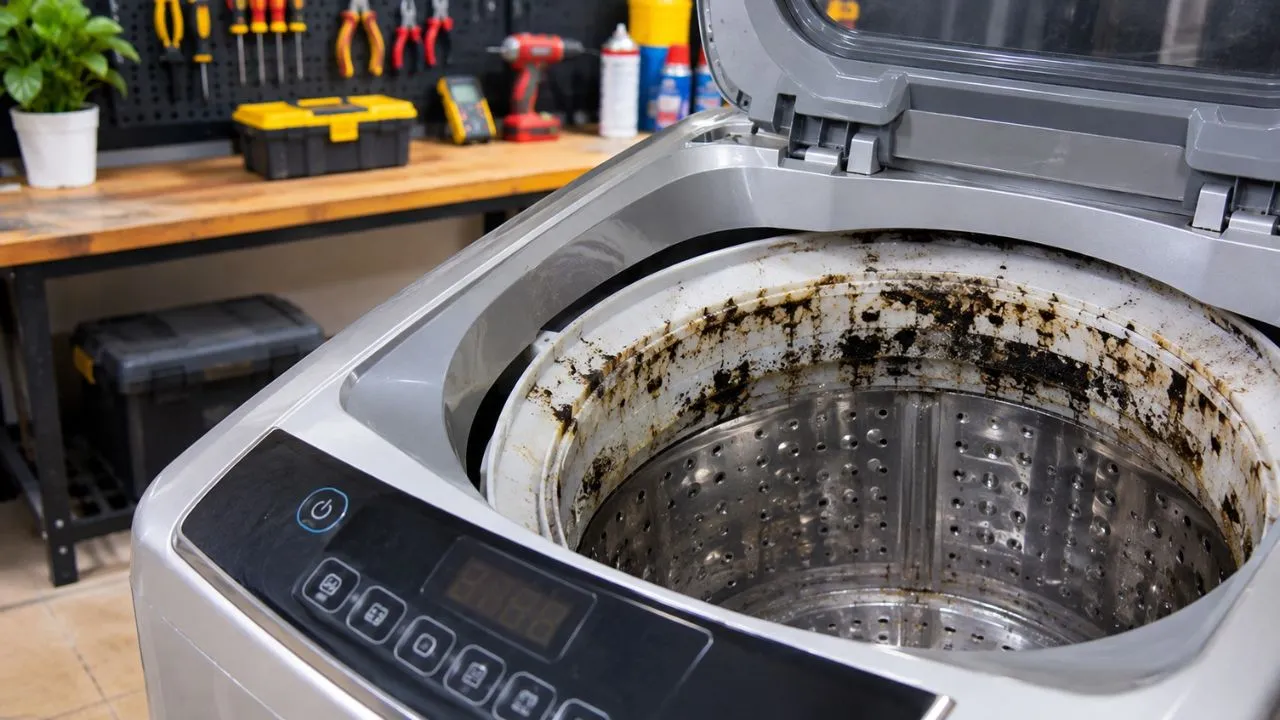
Does your LG washing machine finish the cycle, but your clothes are still dirty, have dark stains, or look like they've barely been washed? It's a pretty annoying problem, especially when the machine turns on normally, fills with water, and doesn't display any error codes.
If an LG or digital washing machine is not washing properly, the causes may be accumulated dirt behind the drum, a loose drive belt in models that use one, problems with the pulsator, excess laundry, detergent residue, or failures in the movement system.
One of the most common problems that often goes unnoticed is lack of maintenance. Even if the drum looks clean inside, a layer of dirt made up of detergent, fabric softener, lint, and fabric residue can accumulate behind its walls. With the movement of the water, some of this dirt can be dislodged and end up stuck to the clothes, even during the rinse cycle.
But not all problems are related to cleaning. If the pulsator doesn't move the clothes properly or the transmission system loses power, the washing performance can also be poor.
In this guide you will learn ten possible causes and how to identify what you should check first, without changing parts unnecessarily.
1. Dirt accumulated behind the drum due to lack of maintenance
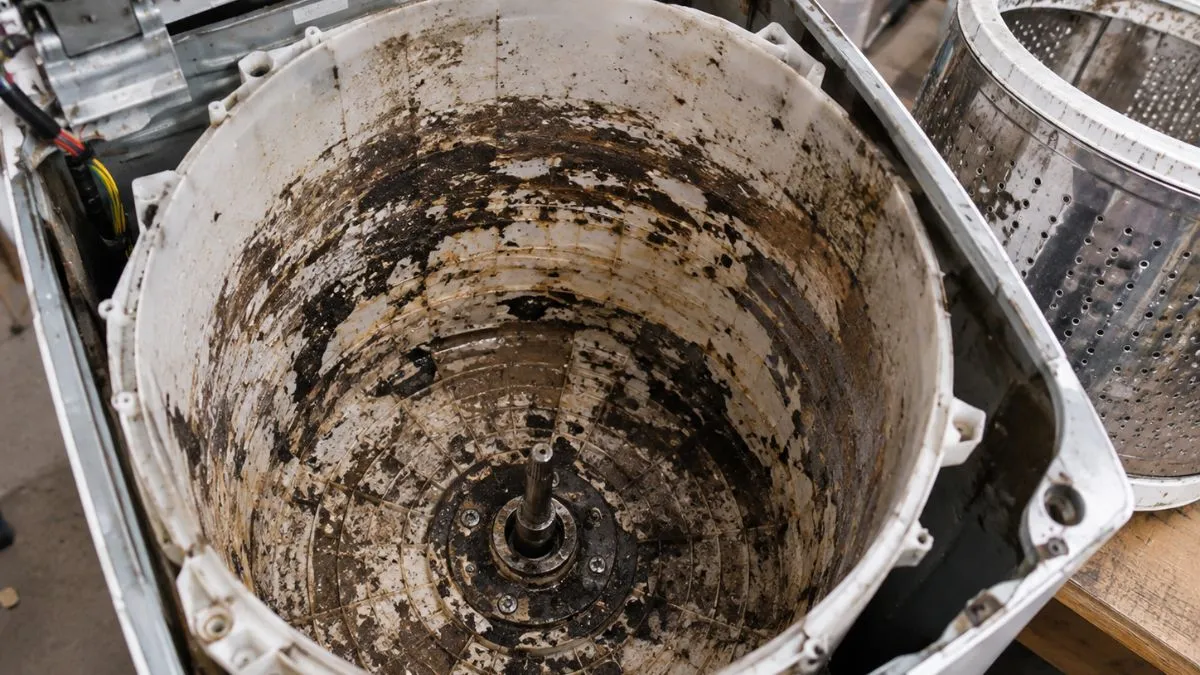
This is one of the first causes you should consider when clothes come out with stains, black particles, or small residues after washing.
Many people believe their washing machine is clean because the stainless steel drum looks shiny. However, most of the dirt can be found in areas that are not visible to the naked eye.
Automatic washing machines consist of an inner drum and an outer tub. Water circulates between these components during operation.
Over time, they can accumulate:
- Remnants of detergent that did not dissolve completely.
- Fabric softener adhered to surfaces.
- Lint and fibers shed from clothing.
- Body grease and dirt from tissues.
- Mineral deposits in water.
- Biofilms and other residues favored by humidity.
When this buildup becomes excessive, it can form a dark or slimy layer on the outer walls of the drum, tub, and other parts.
Why does dirt stick to clothes during rinsing?
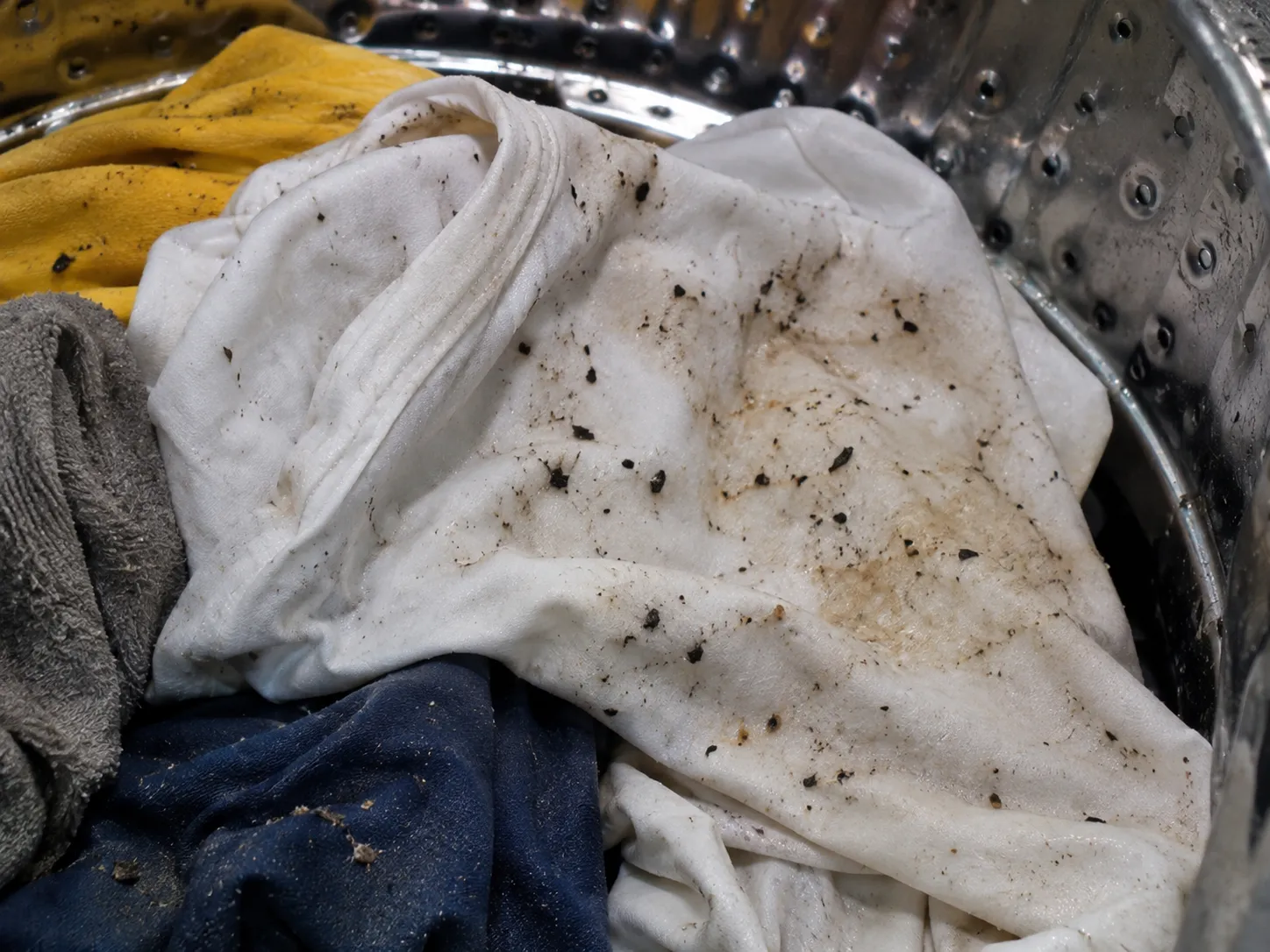
During washing and rinsing, the movement of the water can dislodge fragments of residue accumulated inside the machine.
These fragments circulate along with the water and can become trapped between the fibers of clothing.
That's why some people notice that clothes go into the washing machine relatively clean and come out with small black or brown stains or particles that look like wet dirt.
If dark residue appears repeatedly, especially after rinsing, it is advisable to investigate the cleanliness of the tub.
How to solve this problem?
First, run a tub cleaning cycle without clothes, using a product compatible with your washing machine.
In LG models, this function may appear as Tub Clean, Tub Cleaning, or Drum Cleaning .
If the machine has not been maintained for a long time, it may be necessary to repeat the procedure following the manufacturer's instructions.
However, when there is a very large accumulation of waste, the automatic cycle may not be sufficient.
In those cases, a specialized technician can perform a deep cleaning, disassembling the corresponding components according to the equipment design.
This procedure allows access to areas that normally cannot be cleaned from inside the drum.
Important: Do not disassemble the tub or drum without knowing the procedure for your model. Incorrect intervention may damage seals, bearings, connections, and other components.
2. Loose motor belt or drive belt: the washing machine loses movement
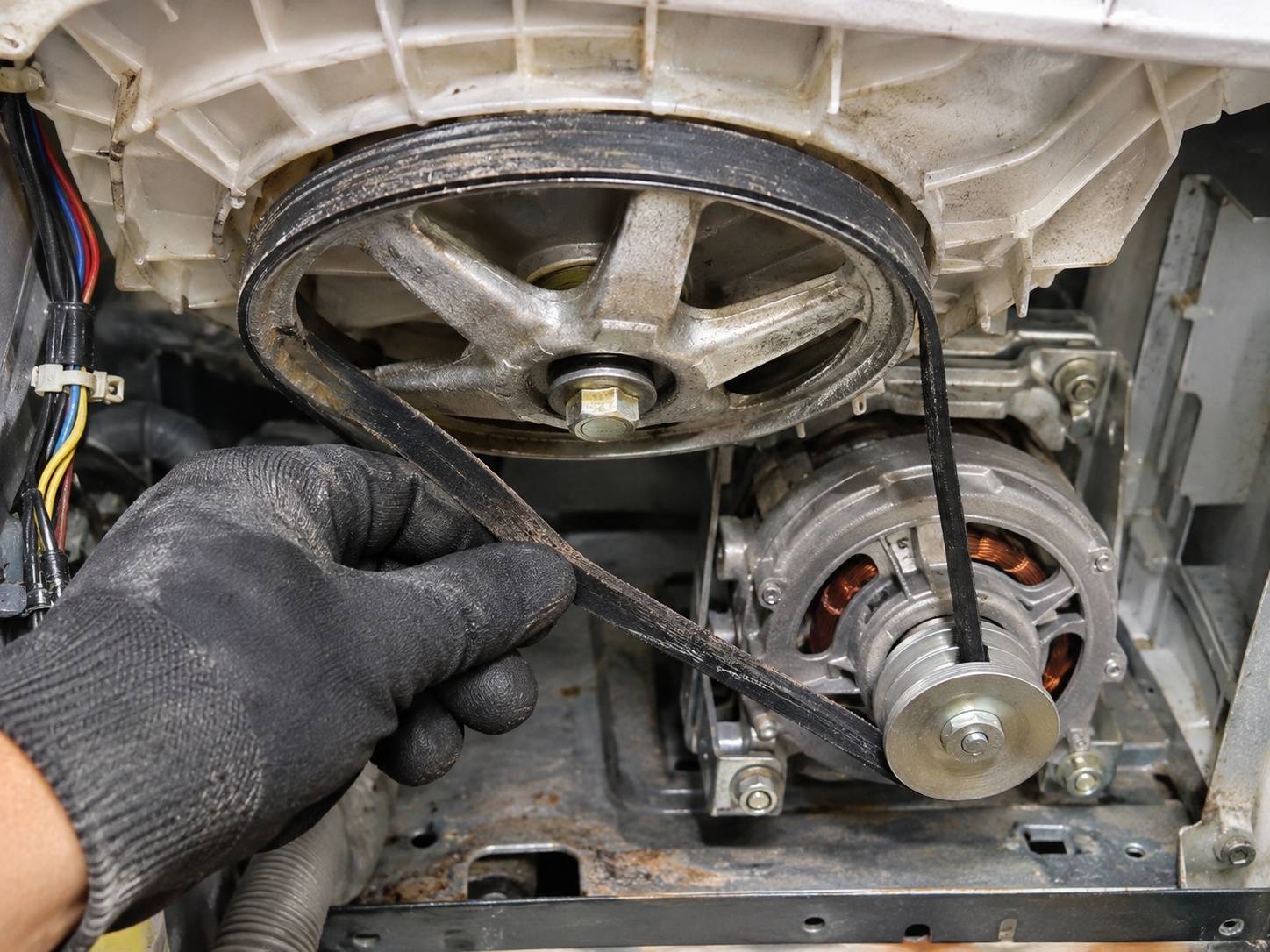
Another fault that can cause poor washing is a worn, loose, or deteriorated drive belt.
This applies to washing machines that use a motor connected by a belt and pulley system.
When the belt loses tension or wears out, it can slip during certain movements.
Instead of correctly transmitting the motor's movement, a portion is lost due to slippage.
This can affect the agitation or rotation of the drum, depending on the machine's design.
Symptoms of a loose band
Signs that may point to this fault include:
- The motor can be heard running, but the clothes barely move.
- The drum or button rotates irregularly.
- Squeaking or sliding noises appear.
- The washing machine has difficulty moving loads that it used to wash normally.
- Cracks, wear, or rubber residue are observed on the belt.
How to check the belt on a washing machine?
With the washing machine unplugged, a technician can access the transmission area and check the condition of the belt and pulleys.
You should check for wear, misalignment, or incorrect tension, always following the model specifications.
In some systems, the motor position can be adjusted. In others, the belt must be replaced with a new one of the correct type.
It is not recommended to install a shorter band to try to increase the voltage without checking the specifications.
Note: Many LG Direct Drive washing machines do not use a belt.
This detail is very important.
LG washing machines with Inverter Direct Drive technology use a direct drive system, so they do not have the traditional belt between the motor and the drum.
If your washing machine is this type, you shouldn't look for a belt that doesn't exist.
In these models, movement problems may be related to other components, such as the motor assembly, its connections, the mechanical system, or the control electronics.
Therefore, before buying a belt, identify the exact model of your washing machine.
3. Worn push button or agitator that does not move the clothes properly.
In top-loading washing machines, the movement of the clothes depends largely on the washing system.
Some use a central agitator and others incorporate a pulsator or washing plate located at the bottom of the drum.
This component moves the water and helps to displace the clothes to remove the dirt.
When it shows wear or coupling problems, it may stop transmitting movement correctly.
How to recognize this fault?
It is possible to observe that the pulsator tries to move, but the clothes remain practically in the same position for a good part of the wash.
Abnormal noises or intermittent movements may also occur.
However, it's important to remember that modern washing machines use gentler movements in certain programs. Not every slow spin indicates a malfunction.
What should you check?
Check if the fault also occurs with a small load and a normal cycle.
If the movement remains abnormal, a technician can examine the coupling, push button, and corresponding transmission mechanisms.
When the splines or joining points are worn, it may be necessary to replace the affected part.
4. Overloading the drum with clothes
Putting in too many clothes is one of the easiest problems to fix.
Even if a washing machine has a nominal capacity of several kilograms, that doesn't mean you should completely fill the drum with compressed clothes.
Clothes need space to move around and allow water and detergent to work properly.
When you put in too many clothes, these problems can occur:
- The detergent is not distributed evenly.
- Some garments barely move.
- Water does not circulate properly between the tissues.
- Rinsing does not remove all residue.
- The garments may come out with stains or unwashed areas.
Solution
Reduce the amount of laundry and select the appropriate program for the fabric and level of soiling.
Avoid compressing the garments to fit in a larger quantity.
If you are going to wash blankets, comforters or bulky items, check that the model has the capacity to move them and that there is a suitable program.
A very large load can make washing difficult even if the motor is working correctly.
5. Excessive detergent or fabric softener
Adding more detergent doesn't always mean better washing.
In fact, using too much product can cause a buildup of foam and residue that ends up affecting both the clothes and the inside of the washing machine.
Excessive detergent can make rinsing difficult, while some concentrated fabric softeners can leave deposits in dispensers and other surfaces.
Over time, these residues can contribute to forming the dirt that sticks behind the drum.
Signs of this problem
Clothes may come out with whitish stains, a sticky feeling, product residue, or an unpleasant smell.
You might also notice excessive foaming during certain stages of the cycle.
Solution
Use a detergent compatible with your washing machine and respect the amount indicated according to the load, the degree of dirt and the characteristics of the water.
If your machine is high efficiency, check that the detergent is appropriate for that system.
Clean the dispenser regularly and avoid pouring concentrated fabric softener directly onto clothes.
6. Clogged lint filter or dispenser
Some top-loading washing machines have a removable lint filter.
When it fills with fibers and debris, it may stop properly retaining some of the particles that circulate during washing.
This can cause clothes to come out with lint stuck to them, especially when towels are mixed with dark garments.
However, not all LG washing machines have a lint filter accessible to the user .
You also shouldn't confuse it with the drain pump filter, which serves a different purpose.
To do?
If your model includes a removable lint filter, remove it following the manufacturer's instructions, clean it, and reinstall it correctly.
Also check the detergent dispenser.
If it is clogged, the product may not be added to the water at the right time, impairing the washing process.
7. Incorrect wash program or gentle drum movement
A digital washing machine can work perfectly and still leave clothes dirty if an inappropriate program is used.
The fast and delicate cycles are designed for specific conditions.
A short program may be sufficient for lightly used garments, but not necessarily for work clothes with grease, dirt or tough stains.
Which program should I use?
It depends on the fabric and the type of dirt.
For heavily soiled, durable garments, it may be advisable to select a normal or intensive cycle, provided the care instructions allow it.
In some models you can also activate functions such as soaking, pre-washing or a higher level of soiling.
Why does my LG washing machine seem to spin very slowly?
Some modern LG washing machines alternate between strong and gentle movements to protect clothes and improve load distribution.
During certain stages, the push button may rotate slowly or change direction.
This does not always mean that the engine has lost power.
The warning sign is that the washing machine has noticeably changed its usual behavior and that the clothes are no longer washed correctly, even using the appropriate program.
8. Low water flow or problems with the valves
The amount and flow of water also influence the washing result.
If the washing machine has trouble filling, some clothes may not get properly wet or the cycle may be interrupted.
Possible causes include:
- Insufficient water pressure.
- Bent inlet hose.
- Blocked inlet filters.
- Faulty filling valve.
- Water level detection problems.
How can I check it?
Check that the supply valve is fully open and that the hose is not crushed.
If the unit indicates a water inlet error or takes too long to fill, consult the model manual.
In high-efficiency washing machines, seeing low water levels doesn't necessarily mean there's a problem. Some use reduced water levels as part of their normal operation.
Do not attempt to tamper with sensors or connections to force the machine to fill with more water.
9. The washing machine does not properly drain the dirty water
If the drainage system is not working as it should, some of the water may remain in the tub when it should be drained.
This can affect rinsing and leave detergent residue or dirt on clothes.
Possible causes include a clogged hose, a faulty drain pump, or a blocked drain filter, if the model has one.
Symptoms
- The clothes end up too wet.
- There is still water at the bottom of the tub.
- The rinse or spin cycle does not finish correctly.
- A drain error code appears.
- You can hear the pump, but the water comes out slowly.
Solution
With the washing machine switched off and unplugged, check that the drain hose is not bent or obstructed.
If you need to clean the pump filter, follow the manufacturer's instructions. Have a container ready because some water may come out.
If the problem persists, it may be necessary to check the pump and drainage system.
10. Engine, clutch, transmission or electronic board failures
When the washing machine receives water, runs the program and does not show significant dirt buildup, but its movement is still incorrect, there may be a mechanical or electrical fault.
In models that use a transmission and clutch, wear can prevent the movement from reaching the washing system properly.
In Direct Drive washing machines, the diagnosis must consider the motor, its connections and the corresponding control system.
It is also possible that a faulty electronic board or sensor could alter the operation of the equipment.
However, these components should not be replaced just because the clothes come out dirty.
How to identify a mechanical or electronic fault?
A technician must compare the equipment's performance with that expected for its model.
It may be necessary to check error codes, electrical connections, mechanical components, and service tests.
These checks must be carried out following the technical manual and safety procedures.
The electronic board should be considered a possibility within the diagnosis, not the first part that is replaced.
Diagnostic table: Why your LG washing machine leaves clothes dirty
Before starting any repairs, observe how the clothes come out and what happens during the wash.
| Symptom | Possible cause | What to check first |
|---|---|---|
| Clothes with black or brown particles | Dirt accumulated behind the drum | Bathtub cleaning |
| Clothes with lint | Filter, mixed fabrics or waste | Accessible filters and classification |
| Washing machine spins with little force | Belt, push button or transmission system | Mechanical model and operation |
| The motor runs, but the drum barely moves. | Belt, coupling or transmission | Drive system |
| Clothes with detergent | Excess product or insufficient rinsing | Dosage and program |
| Clothes are still stained | Overload or improper cycle | Number of garments and program |
| Rinse with dirty water | Internal waste or poor drainage | Tub and water outlet |
| It doesn't finish draining. | Pump, filter or hose | Drainage system |
| Washing machine displays an error code | Fault detected by the control system | Model Manual |
This table is intended to guide the troubleshooting process. To confirm a fault, the corresponding component must be checked.
How to properly clean an LG washing machine that leaves residue on clothes
If dark particles appear after washing, start with maintenance before disassembling the machine.
Step 1. Remove all clothing
The drum must be completely empty before starting the cleaning process.
Check for any coins, papers, hairs, or visible debris that you can remove without disassembling components.
Step 2. Clean accessible areas
With the washing machine unplugged, clean the dispenser, accessible surfaces, and the lint filter if your machine has one.
In front-loading washing machines, also check the folds of the door seal, where moisture and residue can accumulate.
Step 3. Use the tub cleaning cycle
Select the corresponding function on the panel.
Use only a suitable cleaner and the amount indicated for your model.
Do not mix chlorine with vinegar, ammonia, acids, or other cleaning products. These combinations can produce dangerous gases.
Let the program finish completely.
Step 4. Check if particles continue to appear
After maintenance, check if there is any residue left in the drum.
If dark fragments still appear, consult the manufacturer's procedure before repeating the cleaning.
In cases of severe buildup, a deep cleaning by a technician may be necessary.
Step 5. Perform a wash test
Once the machine is clean, try a small load of heavy-duty laundry, using an appropriate program and the correct amount of detergent.
Check if the clothes move normally, if the water drains away, and if the garments end up without residue.
If the problem persists, other causes will need to be investigated.
How often should an LG washing machine be serviced?
As a general guideline, it is advisable to run the tub cleaning cycle approximately once a month, although the frequency may vary depending on usage and the manufacturer's instructions.
A washing machine that is used daily, uses a lot of fabric softener, or washes very dirty clothes may need more frequent attention.
It is also advisable to keep the dispensers and accessible filters clean.
After washing, leave the door or lid ajar when it is safe to do so, to facilitate drying of the interior.
Deep cleaning with disassembly does not have to be performed automatically at a fixed frequency. It is an intervention that should be evaluated according to the condition of the equipment, the accumulated residue, and the manufacturer's recommendations.
How to tell if your washing machine needs maintenance or repair
This difference can help you avoid unnecessary expenses.
It is more likely to need cleaning if the main problem is black residue, stains that look like loose dirt, an unpleasant odor, or detergent residue.
You may need a mechanical check if the motor tries to work, but the button or drum doesn't move as it should.
There may be a water or drainage problem if the machine takes too long to fill, does not drain the water, or leaves clothes with excess detergent.
Several problems can also occur at the same time.
For example, a washing machine that has gone years without maintenance may have accumulated dirt behind the drum and, in addition, show wear on some transmission components.
Therefore, the correct approach is to start with simple checks and only move on to more complex ones when necessary.
Frequently asked questions about LG washing machines that don't wash well
1. Why does my LG washing machine wash clothes, but leave them dirty?
This could be due to a buildup of residue inside the tub, too many clothes, an incorrect program, insufficient agitation of the garments, or rinsing problems. It's best to first check the maintenance and proper use of the machine.
2. Why does my LG washing machine leave black stains on clothes?
A major cause is the buildup of detergent, fabric softener, lint, and other residue behind the drum. With the movement of the water, these deposits can become dislodged and stick to the clothes.
3. What happens if I never clean my washing machine drum?
Over time, residue can accumulate, unpleasant odors can develop, and particles can appear that end up on clothes. Regular maintenance helps reduce these problems.
4. How can I tell if my washing machine belt is loose?
In machines that use belts, some signs include slippage, squeaking, irregular movements, or difficulty transmitting rotation. Confirmation requires physically inspecting the belt and its pulleys with the equipment disconnected.
5. Do LG Inverter Direct Drive washing machines have a belt?
Models with Inverter Direct Drive do not use the traditional belt between the motor and the drum. If they experience movement problems, other components should be checked depending on the model.
6. Why does my LG washing machine spin very slowly during the wash cycle?
This can be normal during certain program movements. However, if the clothes are no longer moving correctly and the wash results have worsened, there may be a mechanical or control problem that needs to be checked.
7. Why does my washing machine make clothes dirty during the rinse cycle?
This can happen when accumulated deposits break off inside the tub and circulate with the water. Drainage problems, lint, excess detergent, or dirt in the water supply can also contribute.
8. Can using too much detergent cause the washing machine to wash poorly?
Yes. Using too much detergent can produce excessive foam, leave residue, and make rinsing difficult. It's best to use the dosage recommended for your washing machine type and load size.
9. Does a tub wash remove all the dirt behind the drum?
Not always. A cleaning cycle can reduce accumulated deposits, but when dirt is heavily ingrained, a more thorough treatment may be necessary. Disassembly should be carried out by trained personnel.
10. When should I call a technician if my LG washing machine isn't washing properly?
When the problem persists after checking the load, detergent, program and maintenance, or when there are abnormal noises, lack of movement, drainage failures or persistent error codes.
Conclusion
If your LG or digital washing machine isn't washing properly, it doesn't necessarily mean the motor is damaged.
Dirt buildup behind the drum is one of the first things you should investigate when black residue or stains appear after rinsing.
If the problem is that the clothes aren't moving correctly, it's a good idea to check the pulsator and the transmission system. In washing machines that use a belt, you should also check for wear or slippage.
Keep in mind that many LG Direct Drive units do not use a belt, so their diagnosis is different.
Proper maintenance and a thorough check-up can help you get a good wash back without unnecessarily changing components.
Does your LG washing machine leave black stains, spin weakly, or simply not remove dirt? Share the model and symptoms in the comments to help us better guide the troubleshooting.